It has been awhile to say the least since my last post. I hope to be posting in the near future. Keep tuned in for the latest common sense.

If I told you a few things about myself would you know who I am?
If I told you that I am for the following could you pick me out of a line up?
Socialized Health care
Organic food
Public School
Ban against smoking
Animal Rights
Nutrition
Minimum Wage
Pension System
Progressive Tax
Plus a few more to add but you will get the point. I challenge anybody to name who I could be. What party am I affiliated to? Who leads my party? I will suprise you with my answer in the comment section and will give more of an explantion in it as well. Good luck and remember things are not always as they seem!
Posted in 106135 | Tagged who am I | 8 Comments »
Starting tomorrow I will be starting my weekly edition with “The Patriot”. As of right now I am without internet in my home. To make a long story short, I am too cheap and internet is too expensive. So to keep a regular posting I am going to focus right now on doing a weekly post. I believe this will also keep the discussion on some of deeper issues going. I hope with it you find that the quality of my research and writing will increase. This will not however hinder me from posting more, such as awesome cartoons or something great on you tube. Thanks for your patience this past couple of weeks and look forward to many great discussions with you.
Posted in 106135 | Tagged expensive internet, the patriot, weekly edition | 3 Comments »
Posted in 106135 | Tagged america, freedom, nra, right to bear arms, second amendment | 5 Comments »
Does anybody believe that the current welfare state is actually helping anybody? I just read a stat that would say no. Back in 1950 1 in 12 people were in poverty and the government spent less than 10 billion on welfare. Today 1 and 6 are in poverty and we spend over 300 billion. That is calculating inflation. So I ask again, is welfare really helping people or does it make them a slave? Doesn’t a welfare state create an environment that takes a persons ambition away? I know what you’re thinking, I don’t care about poor people. That isn’t the case. The case I am posing to you is this, “helping people” is not in the job description of the government. I believe that this burden should fall on the family, church, synagogue, mosque, chapel or temple. In a sense it is us to taking care of us, not via the government. We need to start taking a personal look at those around us and start helping each other. Quit waiting for the government, who doesn’t know what your neighbors needs and help them. We need to quit looking for the hand out and be the hand out. That is the change that will help America and those of our neighbors who are in poverty. As my dad would say, we need to be a “community”. THAT is being an American.
Posted in 106135 | Tagged american spirit, community, government hand out, welfare | 27 Comments »
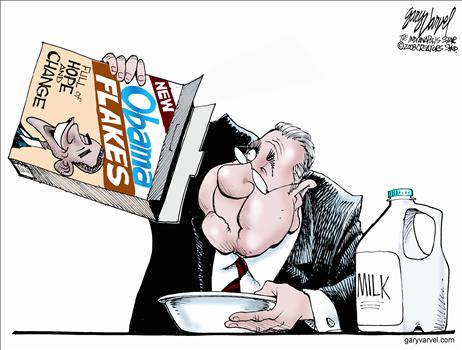
Posted in 106135 | Tagged gary varvel, Obama, political cartoon, towhall | 2 Comments »
DISCLAIMER
If you are about to read this and don’t happen to be a Christian, you might not understand why this is an issue. For that matter you may be a Christian and wonder why this an issue.
—————————–
I have over the past few years discovered some Christians at odds with Patriotism. I am not about to “bash” them for their views. I am simply going to ask questions that I thought about while thinking about that very issue. I will be asking some of those questions in each part. You can participate and answer them in the comments or maybe just let them sink in and chew them over for yourself.
1. What is Patriotism?
2. Does Patriotism get in the way of or supersede your faith? If so, why would it?
3. Isn’t Patriotism just another example of gratitude to God for blessing us with a great country? If not, why? – or – Is being un-Patriotic a lack of gratitude for God’s blessing? If not, why?
4. What happened to the saying “God, Family, and Country”?
Again, this may seem silly to you, but there are some Christians who are troubled by Patriotism. If you are one of them chime in and tell your story, I might be missing something.
Posted in 106135 | Tagged "god\family\country", christianity, patriotism, patriotism and chrisitanity | 3 Comments »
Posted in 106135 | Tagged africa, laura bush, president bush, president dancing | 2 Comments »
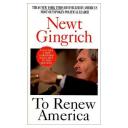
I just started this book last night. From what I have listened to I really like Newt Gingrich. He seems like a genuine guy, the real deal. I have heard bits and pieces of him speaking and really enjoyed the substance of what he says. I really wish he would consider running for president. I think with his knowledge and optimism he would make a great candidate. Here is the table of contents…
1. The Six Challenges Facing America
2. Beginnings
3. Reasserting and Renewing American Civilization
4. America and the Third Wave Information Age
5. Creating American Jobs in the World Market
6. Replacing the Welfare State with an Opportunity Society
7. Balancing the Budget and Saving Social Security and Medicare
8. Decentralizing Power
9. The Contract with America and the Campaign of 1994
10. Implementing the Contract Part 1
11. Implementing the Contract Part 2
12. Learning Versus Education
13. Individual Versus Group Rights
14. Illegal Immigration in a Nation of Legal Immigrants
15. English as the American Language
16. Health Care as an Opportunity in the World Market
17. Health Care as an Opportunity Rather Than a Problem
18. Ending the Drug Trade and Saving the Children
19. Defense for the Twenty-first Century: Reflections of a Cheap Hawk
20. New Frontiers in Science, Space, and the Oceans
21. Tending the Gardens of the Earth: Scientifically Based Environmentalism
22. Violent Crime, Freedom from Fear, and the Right to Bear Arms
23. Why Rush Limbaugh and His Friends Matter
24. The Flat Tax and the IRS
25. The Coming Crisis in Higher Education
26. Corrections Day
27. Unfunded Mandate Reform
28. Term Limits and the Defeat of the Democratic Leadership in the House
29. A New Beginning: The America We Will Create
Sounds exciting right?
Posted in 106135 | Tagged contract with america, newt gingrich, politics, republican, speaker of the house, to renew america | Leave a Comment »
Thomas Paine
you said what…
-
Recent Posts
April 2024 M T W T F S S 1 2 3 4 5 6 7 8 9 10 11 12 13 14 15 16 17 18 19 20 21 22 23 24 25 26 27 28 29 30 Blog Stats
- 24,917 hits


 THE PATRIOT